Architecture
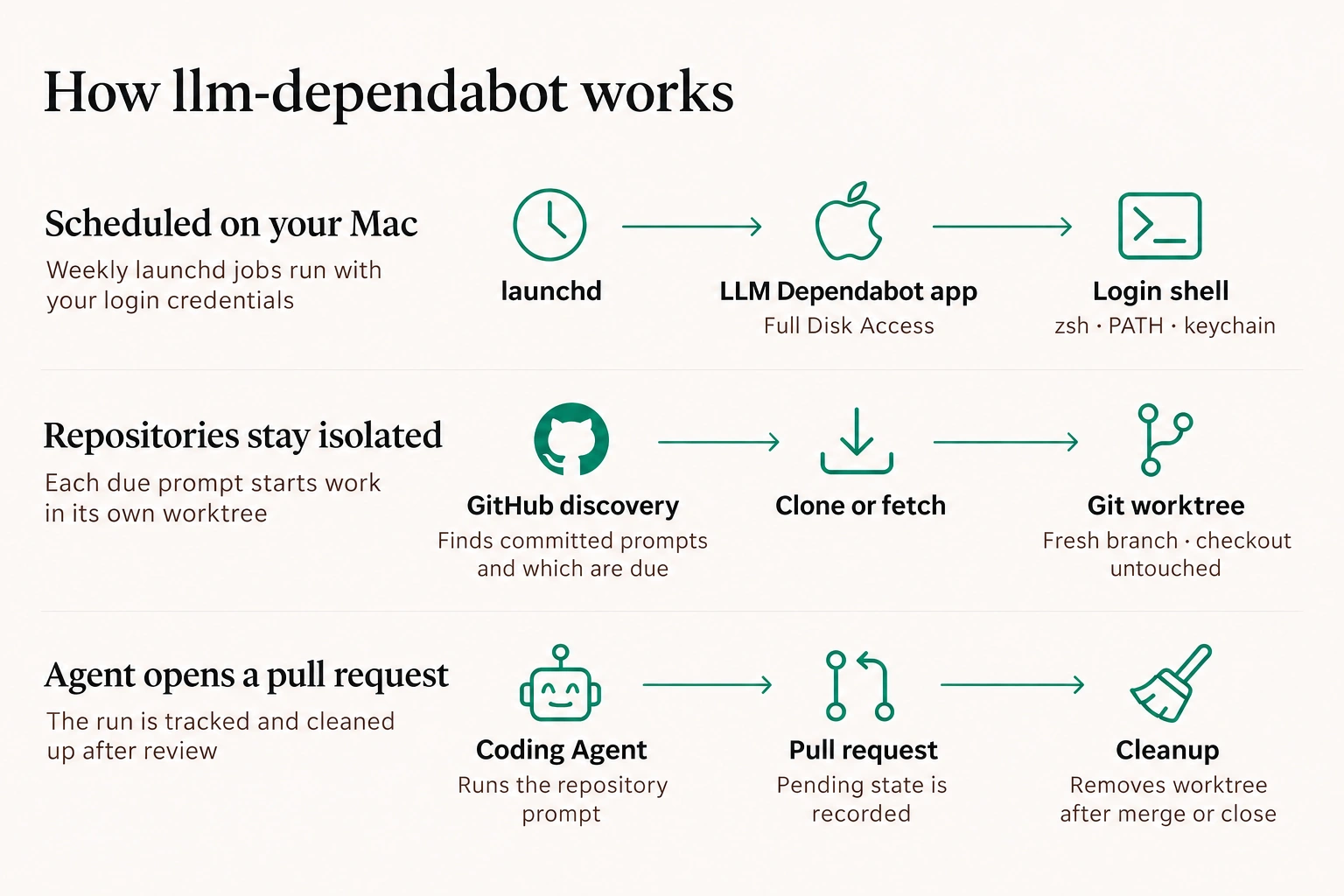
llm-dependabot is a scheduler, not an agent. It decides when, where, and which prompt the agent runs, isolates its work, and cleans up afterwards. The intelligence lives in each repository's own prompts.
Components
| Component | Role |
|---|---|
llm_dependabot.py |
The CLI: a single-file uv script that discovers repositories, runs the agent, tracks pull requests, and writes the launchd agents |
config.yaml and private.yaml |
The prompts, their cadences, the schedule, and which repositories take part (see Configuration) |
app/ |
Sources of the LLM Dependabot app, a tiny launcher that holds the Full Disk Access grant |
| launchd | macOS's built-in scheduler: one agent per group, plus a cleanup agent |
| Coding agent | Runs the prompt and opens the pull request; any agent with a non-interactive mode, set in config.yaml |
gh and git |
Discovery, cloning, worktrees, and pull request state |
The script leans on widely used libraries rather than code of its own:
Typer for the command line and prompts,
pydantic (with its Rust core) to strictly
validate the configuration, state, and gh output, PyYAML to read the YAML, and
filelock to serialise runs.
Process tree
-
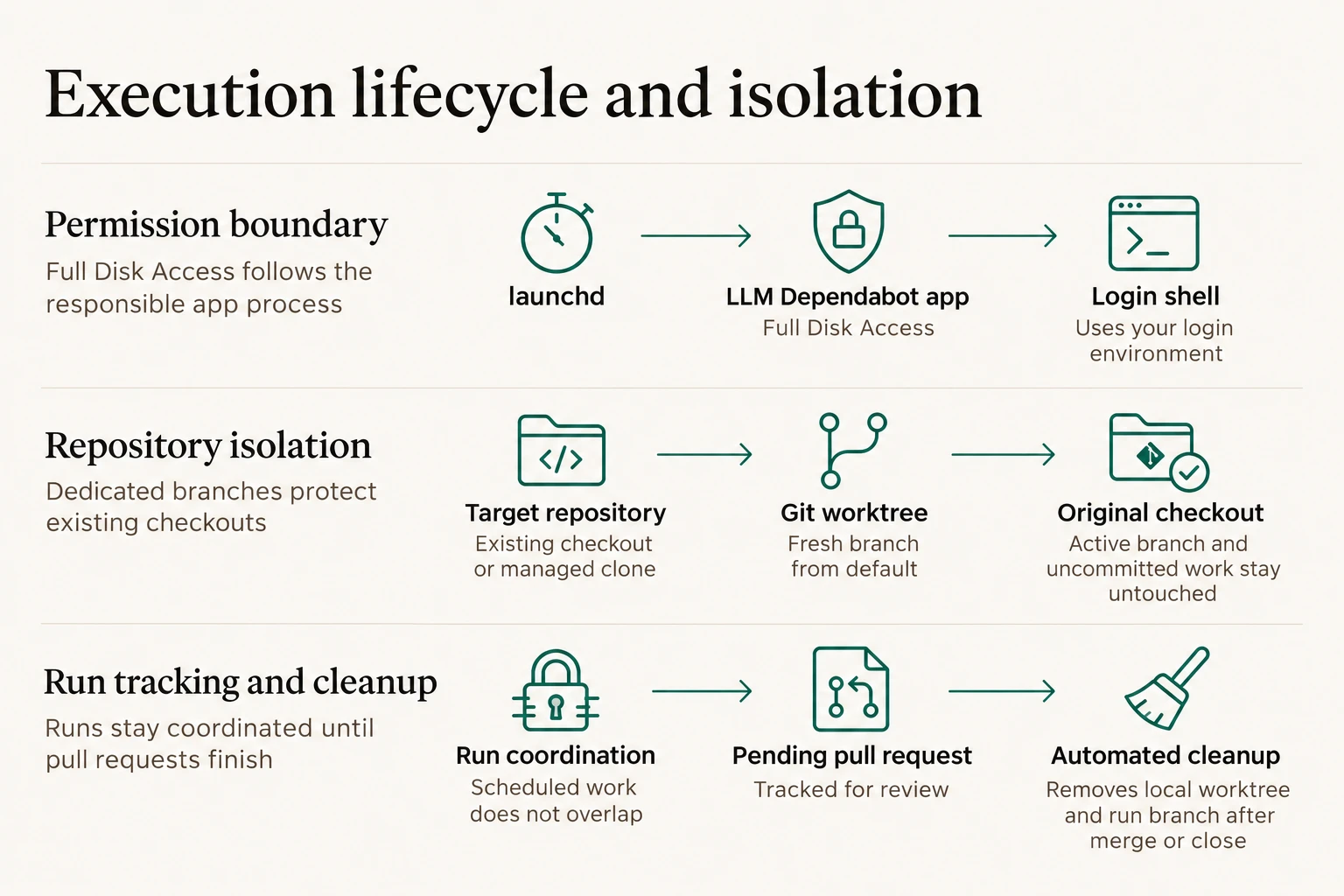
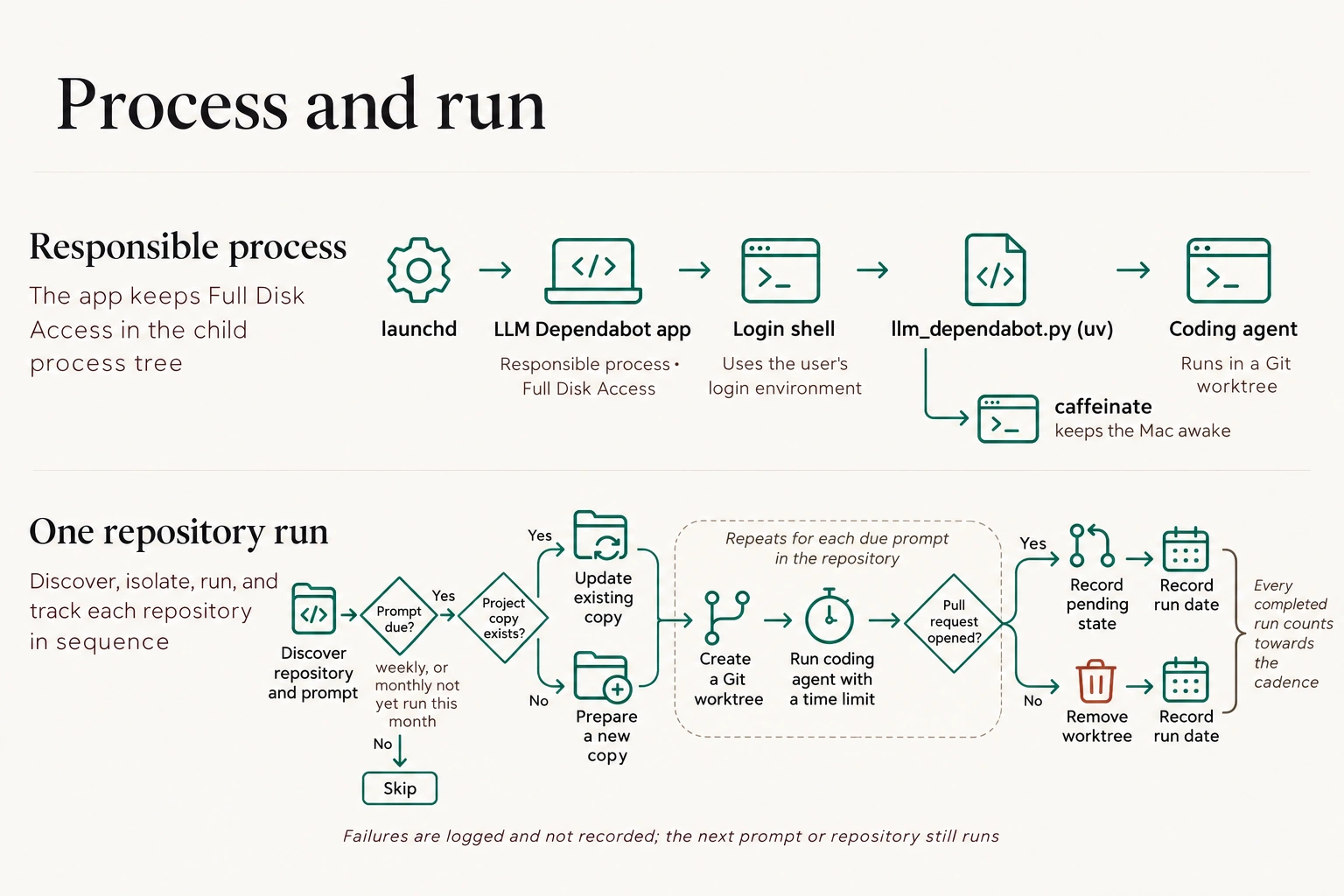
The app starts the job as a child process rather than replacing itself, so macOS treats it as the "responsible process" and applies its Full Disk Access grant to everything below it.
-
A login, interactive zsh gives the job the same
PATHand keychain-backed credentials as a terminal session, so nothing is configured through environment variables.
A run
-
Discovery lists the owner's repositories with
ghand checks each for the configured prompts through the GitHub API, so repositories need not be cloned first. -
Cadence: a run takes every weekly prompt a repository has, plus each monthly one that has not yet run there this calendar month, according to the last runs recorded in
state.json. Launchd starts every group weekly; the script decides what is due, so a missed monthly run catches up the following week. -
Isolation: each prompt runs in its own git worktree and branch, so an existing clone's checked-out branch and uncommitted work are never touched, and each prompt opens its own pull request.
-
Pull request detection looks for a pull request from the run's branch, falling back to one opened by you since the run started, in case the agent chose its own branch name.
-
Repositories and prompts run one after another. A failure in one is logged, and the run moves on. A failed run is not recorded, so it is retried at the next scheduled run.
-
Weekends: with
skip_weekends, scheduled runs and cleanups started on a Saturday or Sunday exit without doing anything. -
A timeout bounds each agent run, backed by a hard stop in case the CLI's own timeout does not fire.
Cleanup
Cleanup runs at the end of every run and on its own schedule. Once a pull request is merged or closed, its worktree and local branch are removed. A clone that did not exist before the run is then deleted, unless it has uncommitted changes, other worktrees, or unpushed commits; it is kept and retried at the next cleanup. A scheduled cleanup that finds a run in progress skips that turn.
State
state.json records pending pull requests (with their worktree and branch),
the clones llm-dependabot created, and the date each prompt last ran in each
repository. It is written atomically, and a lock
keeps a scheduled run and a cleanup from changing it at the same time.